
TV & Electronics Disposal Cost in Fort Worth, TX
Most people pay $70–$140. Updated for 2026.
Local view of our TV & Electronics Disposal cost guide — national ranges, what moves them, and every city we cover.
An old television is one of the few household items you genuinely cannot put in the bin. Most states classify TVs as electronic waste, and in Fort Worth, TX that means they have to go to a recycler rather than a landfill.
Older plasma and CRT sets are the awkward ones: a 55-inch plasma can weigh over 100 pounds and a tube TV contains leaded glass, which is exactly why disposal carries a fee that a flat-screen does not.
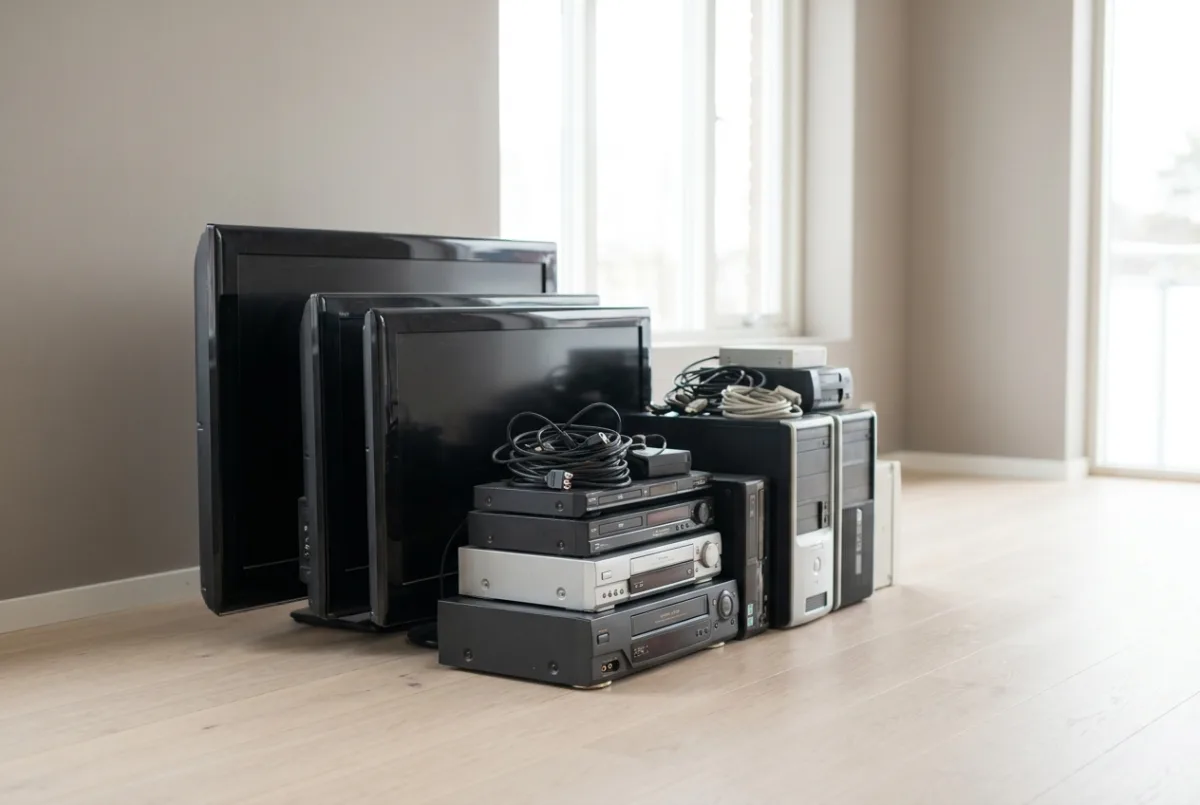
TV & Electronics Disposal in Fort Worth: what actually moves the price
At 65% detached houses, Fort Worth is about as easy as tv disposal gets — driveway, garage door, tailgate. What moves the price here is volume rather than access, so photograph everything you want gone, not just the one item.
Most homes in Fort Worth were built around 1992, and the layout of that era decides more about a tv disposal job than the price list does.
Spread out as Fort Worth is, two pros can quote the same tv disposal job very differently for no reason other than where their truck started the morning.
Residents (2024)
Square miles of land
People per square mile
Local figures: U.S. Census Bureau — Fort Worth city. Checked 2026-08-21.
TV & Electronics Disposal in Fort Worth: where the city stops and a hauler starts
The free route in Fort Worth has hard edges, and they are the reason people end up paying: One pile a month of up to ten cubic yards — about eight feet long, six wide and six tall — at no extra charge, and only one pile per household.
Past those limits the city is not an option at all — not slower, not pricier, simply unavailable. That is the line a hauler exists for, and it is worth knowing exactly where it sits before you start carrying anything.
Collection in Fort Worth is run by City of Fort Worth Environmental Services, Solid Waste. Below is what they will take, straight from their own rules — and where each route runs out.
Taking it yourself
The public drop-off is the city's four Drop-Off Stations. Free: bulk waste, trash, recyclables, yard waste and household chemicals are all accepted. Open to Fort Worth homeowners and some renters.
Checked against the operator’s own page on 2026-09-15. Source
What the regular cart will not take
Each address has an assigned bulk week once a month. The pile goes out by 7 a.m. on that Monday and no earlier than 6 p.m. the Friday before; crews have until the following Saturday at 5 p.m. to reach it, and once they have passed your street nothing more goes out until next month. Keep the pile at least two feet clear of trees, mailboxes, water meters and fences or it is left. Not taken: yard trimmings in plastic bags (they go in paper yard bags with the weekly brush collection), auto parts, batteries and tires, contractor remodelling and demolition debris such as shingles, wallboard and lumber, electronics, any appliance holding coolant, gasoline or chemicals — air conditioners, refrigerators, lawnmowers — dirt, rocks, concrete and ceramic tile, root balls or stumps over eighteen inches with soil, liquids, poisons, explosives and glass. Most of those are taken free at the city Drop-Off Stations instead, and residents may leave four tires there every six months.
Checked against the operator’s own page on 2026-09-15. Source
Why electronics cost more to get rid of
The price is not truck space, it is the recycling gate fee. Screens contain lead, mercury and flame retardants that have to be separated under state e-waste rules, and the recycler charges per unit or per pound to accept them. That fee is passed on to you, which is why a small TV and a small chair cost different amounts to remove.
What changes the price
Screen size and type do most of the work. A modern LED under 40 inches is light and cheap to process; a CRT or plasma is heavy, needs two people and costs the recycler more. Adding a few smaller items — a printer, a monitor, a stack of cables — usually costs far less than booking a second pickup later.
Typical tv disposal cost
$70 – $140
A national range, not a quote. Your actual prices come from local pros bidding on your job.
How JunkerClub works in Fort Worth
Post your job
Describe what needs to go and add a photo. It takes a minute and costs nothing.
Compare quotes
Local pros in Fort Worth bid on your job from your photos — no site visit.
Pay your pro directly
Pick the offer you like. You pay your pro directly when the job is done — cash or card, no platform markup.
TV & Electronics Disposal pricing breakdown
| Service | Typical market price | JunkerClub estimate |
|---|---|---|
| Flat-screen TV (up to 42") | $85 – $140 | $70 – $115 |
| Large or CRT/plasma TV | $120 – $200 | $100 – $165 |
| TV plus assorted electronics | $160 – $260 | $130 – $210 |
Estimates only. The final price depends on how much there is, how easy it is to reach, and what the pro quotes.
How we build these ranges — and why a real quote can land outside them →
TV & Electronics Disposal in Fort Worth — common questions
How much does TV disposal cost in Fort Worth?
Most people pay $70–$140. That is a national range for TV disposal, not a quote — your real price comes from local pros bidding on your photos, and it moves with volume, stairs and how far the item has to travel to the truck.
Can I put an old TV out with the trash in Fort Worth?
Almost certainly not. Televisions are classed as electronic waste in most states and collection crews are instructed to leave them, so the set sits at the curb until someone books a proper pickup. Some retailers take a screen back when you buy a new one — worth asking before you pay for removal.
Is a tube TV really more expensive than a flat screen?
Yes, and by a noticeable margin. CRT sets contain several pounds of leaded glass that recyclers charge extra to handle, and their weight usually turns a one-person job into a two-person one. Mention the type when you post the job so the quotes come back accurate.
What happens to the TV after pickup?
It goes to a certified e-waste processor where the glass, metals and circuit boards are separated for reuse. Working sets are sometimes donated instead. What a reputable pro will not do is put it in a landfill, because in most states that is illegal.
How quickly can it be picked up?
It depends on how many pros cover your area. On our first jobs the first quote arrived within one to three days, and we email you the moment one comes in. Once you pick a pro you choose the date and time window; same-day or next-day pickup is possible when a crew has room on the truck.
What does JunkerClub charge me?
Nothing. Posting a job and collecting quotes is free, and you pay your pro directly when the work is done. The pro pays the platform a small fee only when they win the job — it never gets added to your price.
Do I have to carry it outside myself in Fort Worth?
No — the crew does the lifting and loading, and that labour is most of what you are paying for. In Fort Worth 65% of homes are detached, so most jobs are a driveway carry and the truck can usually get close to the door. The median home here was built around 1992, so doorways and stairs are usually the wider post-war sizes. Say which floor it is on and whether there is a lift when you post the job; that is the part that moves the quote. Housing figures are from the U.S. Census Bureau.
What makes a junk removal quote in Fort Worth different from the national average?
Access and housing type, mostly. In Fort Worth, 65% of homes are detached and the city runs at about 2,878 residents per square mile — nearly every address has its own driveway and garage, so volume matters far more than access. Renters occupy 43% of occupied homes here, which also shapes when the work happens. The prices on this site are national ranges; the number you actually pay comes from local pros bidding on your photos. Housing figures are from the U.S. Census Bureau.
Keep reading
- Junk removal in Fort Worth, TX
- Couch & Sofa Removal cost in Fort Worth
- Mattress Disposal cost in Fort Worth
- Appliance & Refrigerator Removal cost in Fort Worth
- Garage Cleanout cost in Fort Worth
- Apartment & Tenant Cleanout cost in Fort Worth
- Construction Debris Removal cost in Fort Worth
- Hot Tub Removal cost in Fort Worth
- Furniture Removal cost in Fort Worth
- Refrigerator Disposal cost in Fort Worth
- Estate Cleanout cost in Fort Worth
- Hoarding Cleanout cost in Fort Worth
- Yard Waste Removal cost in Fort Worth
- Shed Removal & Demolition cost in Fort Worth
- Piano Removal cost in Fort Worth
- Exercise Equipment Removal cost in Fort Worth
- Office Furniture Removal cost in Fort Worth
- Carpet Removal cost in Fort Worth
- Water Heater Removal cost in Fort Worth
- Trash & Junk Hauling cost in Fort Worth
- Basement Cleanout cost in Fort Worth
- Storage Unit Cleanout cost in Fort Worth
- Foreclosure & Eviction Cleanout cost in Fort Worth
- Scrap Metal Removal cost in Fort Worth
- Tire Disposal cost in Fort Worth
- Above-Ground Pool Removal cost in Fort Worth
- Swing Set & Playground Removal cost in Fort Worth
- Fence Removal cost in Fort Worth
- Deck Removal cost in Fort Worth
- Bulk Trash Pickup cost in Fort Worth
TV & Electronics Disposal prices nearby:
Where the city stops in Fort Worth:
Your junk's last stop.
Free quotes from local pros — no site visit.
Post your job in 2 minutes →Spotted something wrong or out of date on this page? Tell us — we check and fix it.