
Garage Cleanout Cost in Washington, D.C.
Most people pay $250–$550. Updated for 2026.
Local view of our Garage Cleanout cost guide — national ranges, what moves them, and every city we cover.
Garages fill up quietly. A decade of paint tins, broken furniture, bikes nobody rides and boxes nobody has opened, and one day in Washington, D.C. there is no longer room for the car.
Unlike a single-item pickup, a garage cleanout is priced by volume — how much of the truck you fill — which means the number that matters is not what you own but how much of it is leaving.
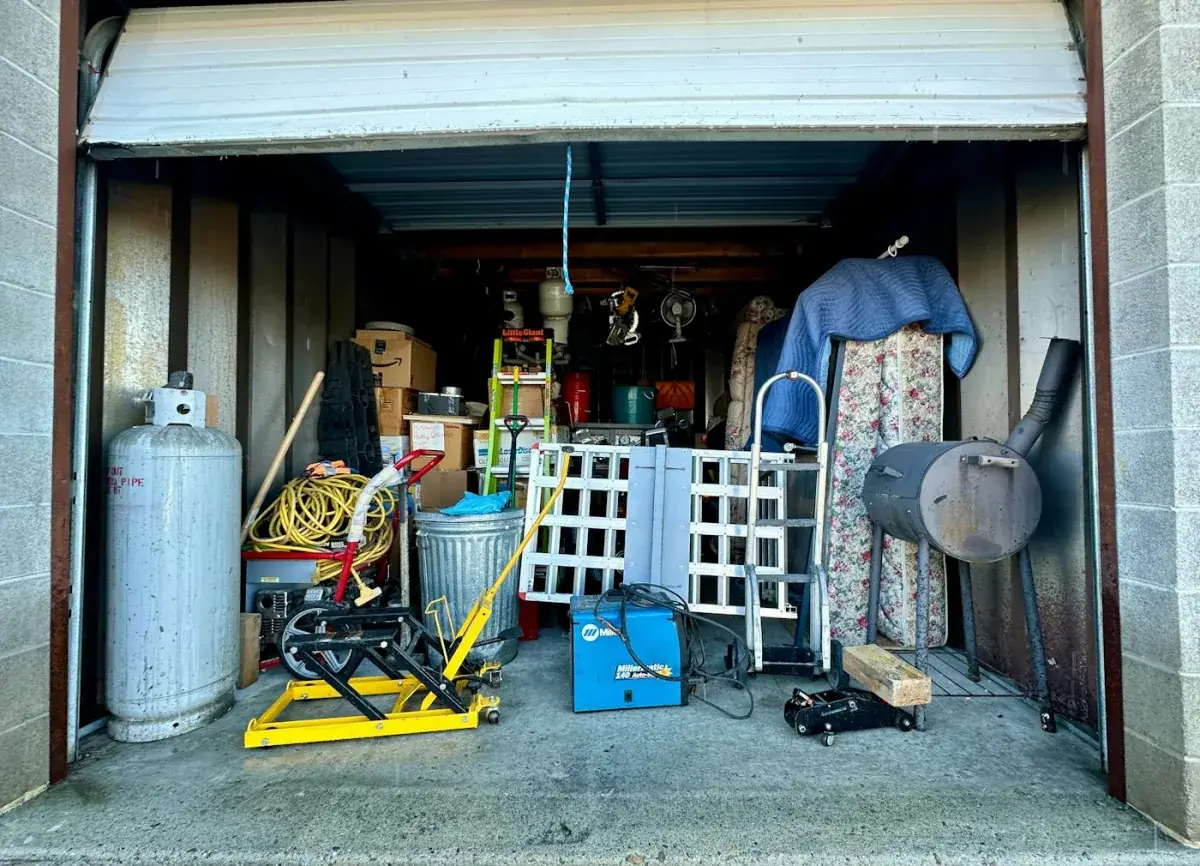
Garage Cleanout in Washington: what actually moves the price
Washington is a row-house city — 33% of homes are single-family but only 11% stand detached. For garage cleanout that means a straight staircase, a narrow front door and a party wall on at least one side. The stairs are the job.
59% of occupied homes in Washington are rented, and month-end is when that shows: garage cleanout bookings cluster around move-out weekends, so a midweek slot is usually the cheaper one.
The median Washington home dates to 1957. Housing of that vintage sets the practical limits on garage cleanout — doorway widths, stair turns and whether there is a basement in the picture at all.
Residents (2024)
Square miles of land
People per square mile
Local figures: U.S. Census Bureau — Washington city. Checked 2026-08-21.
Garage Cleanout in Washington: where the city stops and a hauler starts
The free route in Washington has hard edges, and they are the reason people end up paying: No more than seven items per appointment. More than seven means additional appointment dates.
Past those limits the city is not an option at all — not slower, not pricier, simply unavailable. That is the line a hauler exists for, and it is worth knowing exactly where it sits before you start carrying anything.
Collection in Washington is run by DC Department of Public Works (DPW). Below is what they will take, straight from their own rules — and where each route runs out.
Booked bulky pickup
Large, bulky items from households that receive DPW collection — single-family homes and residential buildings of three or fewer living units. No more than seven items per appointment. More than seven means additional appointment dates. Book through DC 311 — call 311 or use 311.dc.gov. Items go out no earlier than 6:30 p.m. the day before and no later than 6 a.m. on the appointment day. Renovation material is refused outright: bricks, concrete, ceiling tiles, construction and demolition debris and dirt. Buildings of four or more units, condominiums and co-ops must use a private licensed hauler.
Checked against the operator’s own page on 2026-09-03. Source
Taking it yourself
The public drop-off is Fort Totten Transfer Station, 4900 John McCormack Rd NE. No resident drop-off charge is published: the ID check at the gate is what qualifies you. The published fees, charged by material type and tonnage, are for licensed commercial haulers, who have to open an account with DPW on (202) 715-7570 first. Tuesday to Friday, 10 am to 2 pm. Saturday, 7 am to 2 pm. Fort Totten is the only one open to residents — the Benning Road transfer station is closed until further notice. A DC driver's license. Without one, bring a photo ID from another state plus a utility bill from the last 30 days or a copy of your lease or deed, and the names on the two have to match. The load itself has to have come from inside the District, and staff can ask you to prove that as well. Passenger cars, passenger vans, SUVs, pick-up trucks, vans under 15 feet and rental vehicles within those categories are let in. Turned away at the gate: anything on commercial tags, plus sideboards, ladders, stake-bodies, cargo vans, rental trucks longer than 15 feet and tag-along trailers. No cap is published on a resident load. Tires are the exception: four at most, and only on Wednesday, Thursday and Friday between 10 am and 2 pm. A mattress that is not wrapped in plastic. Household hazardous waste, electronics and televisions are not taken here either — those go to DPW's special waste collection events.
Checked against the operator’s own page on 2026-09-09. Source
How volume pricing actually works
Pros quote in fractions of a truck: a quarter load, a half load, a full load. A typical single-car garage clears in a half to a full load. Because the truck is the unit, tidying similar items together before the crew arrives genuinely lowers the price — loose piles take up more space than stacked ones.
What cannot go on the truck
Garages are where hazardous material hides. Paint, solvents, motor oil, pesticides, propane tanks and car batteries are refused by landfills and need a household hazardous waste drop-off, which most counties run for free. Set those aside before the pickup so the crew is not sorting them on your driveway.
Typical garage cleanout cost
$250 – $550
A national range, not a quote. Your actual prices come from local pros bidding on your job.
How JunkerClub works in Washington
Post your job
Describe what needs to go and add a photo. It takes a minute and costs nothing.
Compare quotes
Local pros in Washington bid on your job from your photos — no site visit.
Pay your pro directly
Pick the offer you like. You pay your pro directly when the job is done — cash or card, no platform markup.
Garage Cleanout pricing breakdown
| Service | Typical market price | JunkerClub estimate |
|---|---|---|
| Quarter truck load | $180 – $280 | $150 – $230 |
| Half truck load (typical 1-car garage) | $320 – $480 | $260 – $390 |
| Full truck load | $500 – $750 | $400 – $620 |
Estimates only. The final price depends on how much there is, how easy it is to reach, and what the pro quotes.
How we build these ranges — and why a real quote can land outside them →
Garage Cleanout in Washington — common questions
How much does garage cleanout cost in Washington?
Most people pay $250–$550. That is a national range for garage cleanout, not a quote — your real price comes from local pros bidding on your photos, and it moves with volume, stairs and how far the item has to travel to the truck.
Do I have to sort everything before the crew arrives?
No — hauling and sorting is the job. The one thing worth doing is separating anything hazardous (paint, oil, propane, batteries), because those cannot legally go on the truck and finding them mid-load slows everyone down.
How do I know how much of a truck I need?
You do not have to guess. Post a photo of the garage as it stands and the quotes come back based on what the pros can see, which is far more accurate than describing it in words. A single-car garage usually lands between a half and a full load.
Can anything be donated instead of dumped?
Often a surprising amount — tools, bikes, sports gear and furniture in usable condition. Point out anything worth saving when the crew arrives; most pros run a donation drop as part of the route and it costs you nothing extra.
How quickly can it be picked up?
It depends on how many pros cover your area. On our first jobs the first quote arrived within one to three days, and we email you the moment one comes in. Once you pick a pro you choose the date and time window; same-day or next-day pickup is possible when a crew has room on the truck.
What does JunkerClub charge me?
Nothing. Posting a job and collecting quotes is free, and you pay your pro directly when the work is done. The pro pays the platform a small fee only when they win the job — it never gets added to your price.
Do I have to carry it outside myself in Washington?
No — the crew does the lifting and loading, and that labour is most of what you are paying for. In Washington about 22% of homes are attached rather than detached, so a straight internal staircase and a narrow front door tend to set the limits instead of a driveway. The median home here was built around 1957; single-width staircases are common in that stock and lifts are rare. Say which floor it is on and whether there is a lift when you post the job; that is the part that moves the quote. Housing figures are from the U.S. Census Bureau.
What makes a junk removal quote in Washington different from the national average?
Access and housing type, mostly. In Washington, 11% of homes are detached and the city runs at about 11,489 residents per square mile — most homes here are attached rather than detached, so the front staircase and the doorway set the limits rather than a driveway. Renters occupy 59% of occupied homes here, which also shapes when the work happens. The prices on this site are national ranges; the number you actually pay comes from local pros bidding on your photos. Housing figures are from the U.S. Census Bureau.
Keep reading
- Junk removal in Washington, D.C.
- Couch & Sofa Removal cost in Washington
- Mattress Disposal cost in Washington
- TV & Electronics Disposal cost in Washington
- Appliance & Refrigerator Removal cost in Washington
- Apartment & Tenant Cleanout cost in Washington
- Construction Debris Removal cost in Washington
- Hot Tub Removal cost in Washington
- Furniture Removal cost in Washington
- Refrigerator Disposal cost in Washington
- Estate Cleanout cost in Washington
- Hoarding Cleanout cost in Washington
- Yard Waste Removal cost in Washington
- Shed Removal & Demolition cost in Washington
- Piano Removal cost in Washington
- Exercise Equipment Removal cost in Washington
- Office Furniture Removal cost in Washington
- Carpet Removal cost in Washington
- Water Heater Removal cost in Washington
- Trash & Junk Hauling cost in Washington
- Basement Cleanout cost in Washington
- Storage Unit Cleanout cost in Washington
- Foreclosure & Eviction Cleanout cost in Washington
- Scrap Metal Removal cost in Washington
- Tire Disposal cost in Washington
- Above-Ground Pool Removal cost in Washington
- Swing Set & Playground Removal cost in Washington
- Fence Removal cost in Washington
- Deck Removal cost in Washington
- Bulk Trash Pickup cost in Washington
Garage Cleanout prices nearby:
- Arlington, TX · 4.9 mi
- Arlington, VA · 4.9 mi
- Hyattsville, MD · 5.1 mi
- Takoma Park, MD · 5.3 mi
- Silver Spring, MD · 6.8 mi
Where the city stops in Washington:
Your junk's last stop.
Free quotes from local pros — no site visit.
Post your job in 2 minutes →Spotted something wrong or out of date on this page? Tell us — we check and fix it.